


SIEM and Security Awareness Training: How ERPSM Builds a Modern Human‑Centric SOC
In today’s digital landscape, SIEM and Security Awareness Training play a crucial role in safeguarding against increasing cyber threats.
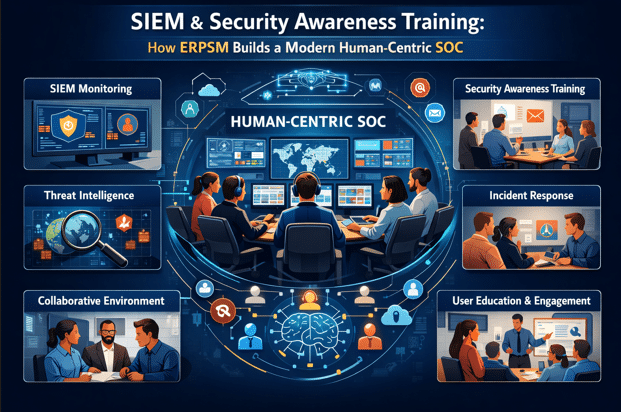
SIEM and Security Awareness Training: How ERPSM Builds a Modern Human‑Centric SOC 12
Integrating SIEM and Security Awareness Training is essential for building a robust defense against social engineering attacks.
Between 2023 and 2026, AI‑driven social engineering attacks have surged worldwide.
In South Africa alone, Business Email Compromise accounts for roughly 40% of reported cyber incidents, with average SME losses around R340,000 per attack.
Security Information and Event Management platforms deliver powerful security monitoring and continuous monitoring of network traffic, system logs, and event data. However, they cannot stop an employee from clicking a malicious link.
ERP Software Management (ERPSM) addresses this by combining managed SIEM, incident response, and KnowBe4‑powered cybersecurity awareness training to harden both technology and people.
This article covers what SIEM is, where it fits in security operations, why human error still drives most security incidents, and how ERPSM’s partnership with KnowBe4 closes that gap – especially for SMEs needing stronger event management, threat intelligence, and compliance management without building a massive internal SOC team.
The combination of SIEM and Security Awareness Training helps organizations proactively address vulnerabilities.
What Is ERPSM SIEM? From Log Collection to Security Event Management and Incident Detection
SIEM is a central platform that collects, normalizes, and correlates log data from multiple sources, including firewalls and cloud services. This technology analyzes data in real time, making it the backbone of comprehensive security monitoring. The SIEM market is projected to reach $11.3 billion by 2026.
Core capabilities of any modern siem tool include:
- Log management and data aggregation – siem tools automate log aggregation and analysis to reduce manual workload, pulling security data from multiple systems and data sources including cloud workloads and on‑premises infrastructure
- Event correlation using advanced analytics – siem software uses rules and AI to correlate data, identify potential threats, and detect threats such as brute‑force logins, impossible travel, and data exfiltration across cloud environments
- Risk‑based alerting – siem systems generate alerts based on predefined thresholds and rules; automated alerts reduce analyst workload by 30%, and siem solutions enhance incident response efficiency through risk-based alerting
- Incident detection and forensics – SIEM facilitates forensic investigations by centralizing log data and historical data, letting security analysts search months of records; SIEM technology improves mean time to detect incidents by 50%, and SIEM improves mean time to detect (MTTD) and mean time to respond (MTTR) overall
- Compliance reporting – SIEM solutions generate reports that help organizations meet compliance requirements for PCI-DSS and GDPR; SIEM automates compliance reporting for regulatory frameworks such as GDPR and HIPAA; SIEM solutions help organizations meet PCI-DSS, GDPR, and HIPAA requirements; and SIEM can generate real-time compliance reports for various standards relevant in South Africa (POPIA) and globally
SIEM eliminates blind spots in security monitoring and assists organizations in proactively hunting for threats. Many SIEM solutions utilize AI for improved data analysis and enhanced threat detection, which can identify both known and unknown threats.
Modern SIEM integrates with newer technologies like SOAR and XDR solutions for enhanced security. While xdr solutions offer extended detection and response across specific layers, and security orchestration (SOAR) automates playbook‑driven response, SIEM remains the security information management and analytics hub. Modern siem platforms support monitoring across hybrid environments, including cloud and on-premises, covering cloud computing workloads alongside traditional network security.
SIEM consolidates event data from multiple sources for centralized monitoring.
Centralized dashboards enhance team collaboration during incidents.
SIEM enables centralized compliance auditing by documenting evidence for audits and broader regulatory obligations across business infrastructures.
Automated data collection in SIEM reduces compliance management burdens.
SIEM streamlines compliance reporting for multiple regulations and can detect potential compliance violations early – satisfying compliance and auditing requirements for standards like ISO 27001 and PCI DSS.
SIEM reduces resource usage by automating log analysis, freeing security personnel and security professionals for higher‑value work while robust data privacy and POPIA-aligned policies safeguard how security data is collected and processed.
By utilizing SIEM and Security Awareness Training, companies can better prevent incidents caused by human error.
For effective security measures, organizations should not overlook the importance of SIEM and Security Awareness Training.

Where SIEM Struggles: Human‑Driven Attacks, Social Engineering, and False Positives (Pty Ltd)
Incorporating SIEM and Security Awareness Training into your security strategy can significantly enhance protection.
Even a well‑tuned siem solution struggles when attackers exploit human error. In South Africa, approximately 2,677 out of 3,219 data breach notifications in a recent 12‑month span were caused by non‑malicious human mistakes – not sophisticated hacks. Phishing, spear‑phishing, and MFA fatigue attacks all begin with a single user click that no siem platform can prevent.
With a focus on SIEM and Security Awareness Training, organizations can address the human element of security.
Effective SIEM and Security Awareness Training can transform how security incidents are managed.
SIEM systems are integral in security operations centers to detect and analyze security events – but detection happens after the click.
Security teams see the aftermath in security alerts: unusual login locations, mass mailbox rule creation, or large downloads following a compromised credential.
Behavioral analytics in modern SIEM systems reduce false positives, yet alert overload still buries true security issues in understaffed SOCs.
Intelligent automation reduces the burden of manual security tasks, but purely technical controls don’t address the root cause when staff repeatedly fall for the same social engineering tricks.
Collaboration between SIEM and Security Awareness Training leads to a stronger security posture.
Collaboration between SIEM and Security Awareness Training leads to a stronger security posture.
The lesson: training the “human sensor network” reduces noisy security events in your siem systems, cuts repetitive incident response work, and lets security analysts focus on real potential threats.
Security Awareness Training with KnowBe4 and Innovation Worx: Strengthening the Human Layer
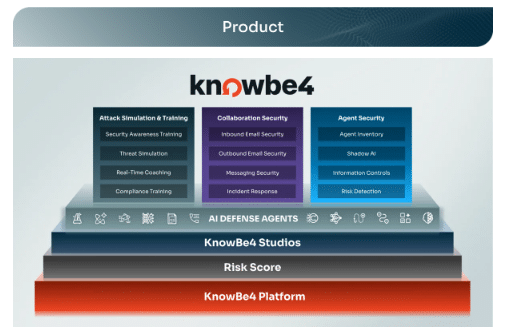
ERPSM partners with KnowBe4 – a globally recognized platform that has analyzed over 42 million phishing simulations across 14.8 million users – to deliver continuous cybersecurity training, not annual checkbox exercises, supporting broader corporate cybersecurity training and resilience.
Programme elements include:
Integrating SIEM and Security Awareness Training ensures all employees are equipped to handle threats.
- Micro‑learning modules covering phishing, passwords, ransomware, sensitive data handling, and remote‑work hygiene
- Simulated phishing campaigns with adaptive difficulty, including AI‑generated scenarios across email and SMS
- Automated follow‑up coaching for high‑risk users who repeatedly fail tests
- Localised content aligned with real cyber threats observed in South African businesses
The synergy of SIEM and Security Awareness Training enhances organizational resilience against attacks.
The results speak clearly. KnowBe4’s benchmarking data shows untrained users have a baseline “phish‑prone percentage” of 34.3%. After 90 days of training that drops to 18.9%, and after one year it reaches just 4.6% – a 79% reduction despite a 17.1% spike in global phishing volume. This directly improves your organization’s security posture and overall security posture.
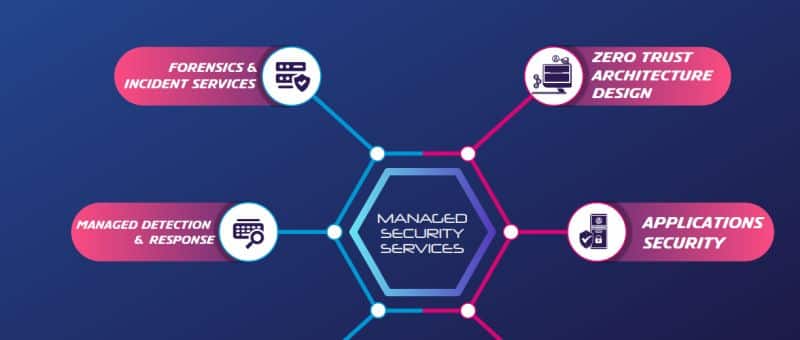
ERPSM’s role as a managed security service provider goes beyond deploying the platform.
We design the training calendar, interpret KnowBe4 reports alongside threat intelligence from SIEM, and brief leadership on security measures, culture shifts, and policy improvements.
Risk scoring lets management see exactly which departments concentrate risk – turning compliance data and security information into actionable security management decisions.
Integrating SIEM and Security Awareness Training ensures all employees are equipped to handle threats.
SIEM and Security Awareness Training: How ERPSM Builds a Modern Human‑Centric SOC 13
The synergy of SIEM and Security Awareness Training enhances organizational resilience against attacks.
Bringing It Together: ERPSM’s Managed SIEM, ERP Software Management, Cybersecurity Services, Threat Detection + KnowBe4 for a Modern SOC
Investing in SIEM and Security Awareness Training is crucial for maintaining compliance and security integrity.
Ultimately, SIEM and Security Awareness Training work together to combat the evolving threat landscape.
All departments should prioritize SIEM and Security Awareness Training for comprehensive coverage.
ERPSM operates SIEM for clients end-to-end: onboarding log sources, creating correlation rules mapped to MITRE ATT&CK, and providing real time monitoring. AI-driven automation improves incident response significantly. This promotes threat detection and response capabilities that would otherwise require a full in-house team.
By emphasizing SIEM and Security Awareness Training, organisations can create a culture of security supported by tailored cybersecurity solutions from a Microsoft partner in South Africa.
Contact us to learn how SIEM and Security Awareness Training can benefit your organization.
The feedback loop is where the real value emerges. Patterns in SIEM – credential phishing, cloud account abuse, suspicious network traffic – directly inform the next KnowBe4 campaign content ERPSM recommends. Every third-party vendor introduces potential risks, and vendor risk management helps identify and mitigate cybersecurity threats. Organizations with strong vendor risk management protect sensitive data better. This means training stays relevant to actual security threats your people face, not generic scenarios. In ERP environments, cybersecurity includes monitoring threats, securing data, and applying threat mitigation strategies to manage cybersecurity risks.
Example scenario: A simulated phishing campaign reveals high failure rates in a finance department. ERPSM cross‑references this with SIEM data showing privileged access patterns and anomalous logins. Third-party risk management identifies high-risk vendors and helps mitigate operational disruptions. We deploy focused training for finance, implement stricter controls, and within 90 days the department’s phish‑prone rate and related SIEM security alerts both drop measurably – improving incident detection rates, protecting sensitive financial records and personal information, and the organization’s overall readiness for audits and cyber insurance questionnaires.
Key benefits for SMEs and enterprises: ERP reduces operating costs by consolidating multiple software packages, especially when paired with Microsoft cloud and Dynamics 365 solutions. It also improves procurement by streamlining purchasing and supplier management, with better oversight across procurement and supply chain operations. CIPS training can improve procurement efficiency and reduce risks for teams. A CIPS qualification can strengthen a procurement career and lead to MCIPS membership recognition. The CIPS Level 4 Diploma is designed for working professionals.
Capability | Outcome |
|---|---|
Managed SIEM with real time monitoring | Faster threat detection; identify threats before damage spreads |
KnowBe4 awareness training | Fewer successful social engineering attacks |
SIEM + training feedback loop | Analysts focus on real security incidents, not repeat clicks |
Compliance reporting automation | Audit‑ready evidence for POPIA, GDPR, PCI DSS, and meeting compliance requirements plus regional and global governance standards |
Antivirus software and endpoint integration | Correlated alerts across the entire network from all data sources |
ERP also optimizes inventory management by reducing stock shortages, and users should be aware of the website terms and conditions governing ERP Software Management services. |
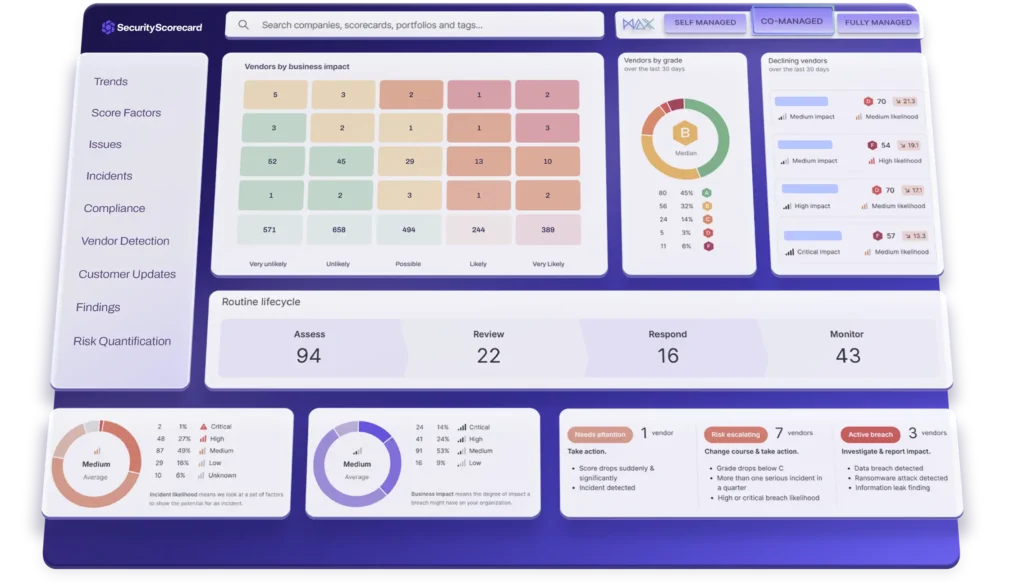
Regulators require oversight, vendor risk management is essential for maintaining regulatory compliance, and CEOs rank third-party risk as a leading cybersecurity challenge, driving interest in Zero Trust security models.
SIEM as an event management siem platform paired with human‑layer training transforms your security posture from reactive to resilient.
Together they analyze data, identify threats, and detect threats across your infrastructure while your people learn to recognize and report the attacks that no technology alone can stop.
ERP Software Management has been an approved exam centre since 2018 and provides a dedicated study center and contact point for cybersecurity and CIPS training services.
Ready to close the gap between technology and people? Contact ERPSM to assess your current security monitoring and awareness posture, and explore how managed SIEM plus KnowBe4 training can strengthen your defences in 2026, backed by over 12 years of experience in vendor risk management services and a shared focus on your long-term success—visit us to get started.
Contact us to learn how SIEM and Security Awareness Training can benefit your organization.

One Response